SHIKISHINAISHINNO

New collection of ancient and modern waka poems
SHINKOKINWAKASYU

3
spring song

YAMAFUKAMI
HARUTOMOSHIRANU
MATSUNOTONI
TAEDAEKAKARU
YUKINOTAMAMIZU

author:
SHIKISHINAISHINNO

Meaning 1:
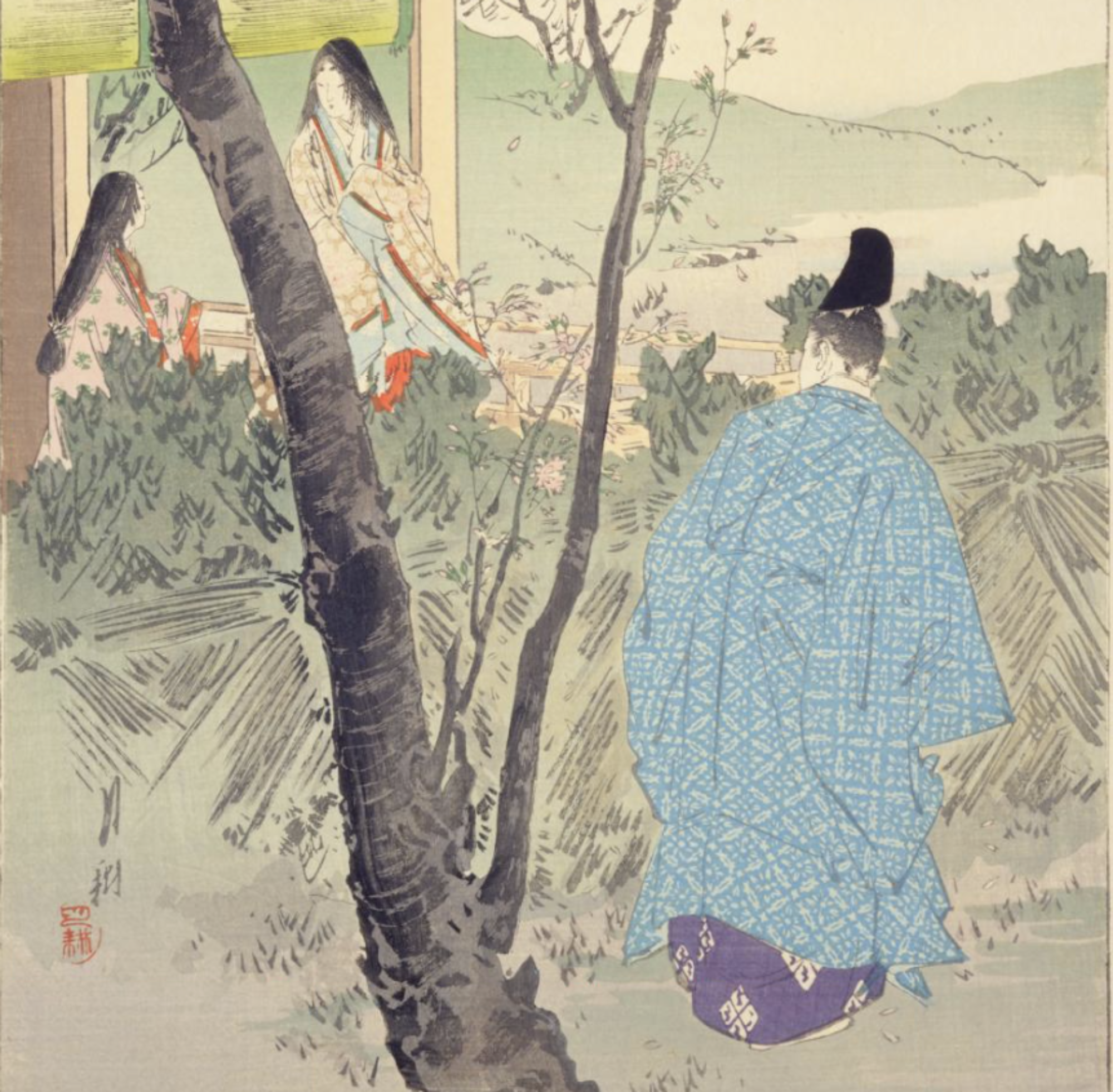
The village is deep in the mountains, so when you don’t even know that spring has come, raindrops from melting snow fall from the eaves onto the door made from tied pine branches. Ah, it’s already spring.

Meaning 2:
The author, who lives in a mountain village, does not even know that spring has arrived. Drops of melted snow fell from the eaves onto the rough door. The author thinks to himself, “Oh, it’s already spring.”

Short short:
Ah, it’s already spring
It’s snowmelt water!

Imperial Princess Shikishi:(SHIKISHINAISHINNO)
Daughter of Emperor Goshirakawa. A person who had a job as a servant of the gods at Kamo Shrine in 1159. It seems she was single all her life. She was born in 1149 and died in 1201. Japanese imperial family.
She is the third daughter of the 77th Emperor Goshirakawa. She spent ten years of her teenage years as a Kamo Saiin, and even after her retirement she remained single for the rest of her life.

What is Tanka (WAKA)?

It is one of the Japanese short poems that has a 31-syllable form: 5, 7, 5, 7, 7. The differences from haiku, which is also a short poem and has a five-seven-five 17-syllable format.

■Differences in content

Tanka… Read with a focus on “me” .

“How to make Waka”

“Write down what you think”

Write down what you thought about it, even if it’s just one sentence, and use it as the basis for 5-7-5-7-7.

The theme can be something familiar to you.

Fujiwara Teika

I started reading Love Poetry 1 of the “Shin Kokin Wakashu”written by Fujiwara Teika and others. I will take these 90 poetrys and transform them into modern songs. It may be a modern translation. I am also going to compare it with Love Poetry 1 from ” Kokin Wakashu”, which was published the other day.

The characteristics of the ”Shin Kokin Wakashu”are said to be fantastic, aesthetic, and painterly. It is also said that Teika developed the world of “yūgen”that is said to have been proposed by his father, Toshinari.

At the same time, I am also reading a book related to Fujiwara Teika’s 50-year diary, ”Meigetsuki”.

Teika Fujiwara is an interesting man.

Tanizaki Junichiro’s works

I had the opportunity to read Tanizaki Junichiro’s works in succession. I had read some of his literature in the past, but reading it again revealed his deep knowledge of Japanese classics.
I re-read “Shousho shigemoto’s Mother” and “Shunkinsho.
They vividly describe how Japanese women lived, and the classical literature that is the starting point of his literature is reflected in modern literature. The state of things was shocking.
I thought that “waka” was revived in his literature in the modern age.

It is a national asset of Japan.

The year of establishment and author of each.

Manyoshu: Compiled by Otomo Yakamochi and others around 780
Kokin Wakashu: 905, compiled by Kinotsurayuki and others
The Tale of Genji: Around 1008, Murasaki Shikibu
Meigetsuki: 1180, Fujiwara Teika
New Kokin Wakashu: 1210, compiled by Fujiwara Teika and others
Hojoki: 1212, KamonoChomei

It is a national asset of Japan.

This darkness is the origin of Japanese beauty.

Author Junichiro Tanizaki talks about the value of Japanese tatami rooms. I would like to write down each of the conditions one by one.

1. The room should be slightly dark.
1. Japanese people use candles because they can’t see anything in a dark room.
1. The flame of a candle sways when the air moves.
1. When the flame sways, the scenery in the room sways in time with the candlelight.
1. This darkness is the origin of Japanese beauty.
1. Japanese people enjoy things that are faintly visible. In a dark room.
1. When you can see everything clearly, you no longer need imagination to see things.
1. Everything that can be faintly seen in the dark is beautiful.
1. This darkness is the origin of Japanese beauty.


⚫︎Enjoy with sound Japanese old poetry ”Waka” for beginners

Go to Amazon sales site


Paper book:
A5 size book (Japan only)
194 pages

For e-books: Kindle version
Published March 1, 2024

The era of Fujiwara Teika

He started reading a book about Fujiwara Teika. This story takes place from the end of the Heian period to the beginning of the Kamakura period. It was a turning point in Japan’s transition from the age of aristocrats to the age of samurai. We will try to understand this by looking at Fujiwara Teika’s diary called Meigetsuki, which was started in 1211. Fujiwara Teika was a Heian aristocrat who had copied Kokin Wakashu many times.

Plants,birds appear in waka poems

The Japanese nightingale, Japanese clover, and chrysanthemum appear in waka poems. The setting for these birds and plants must be outside the residence where the residents live, that is, their garden. What kind of gardens were they? They can see the moon, see plants, and hear birds from inside their homes.


Waka and garden at Ryoan-ji

Foreigners seem to be interested in old Japanese culture. I think that old Japanese culture can be felt in Japanese waka (old Japanese poetry), haiku (Japanese standard form of poetry from the Edo period), Japanese tea ceremony philosophy, Japanese garden culture, Buddhist statues that could be called old Japanese sculptures, and, above all, old Japanese architecture. They all have their own charm. What do foreigners find attractive about old Japan?

The period when waka poems were composed actively was the period when Japanese culture was adopting Chinese characters and institutions. It was also a time when Japan was changing from Chinese culture to its own unique culture. Therefore, the period of waka poetry is different from that of the later Wabi and Sabi culture. Nevertheless, I believe that the origin of the Japanese sensibility, which later became clear, can be found in these waka poems.

In particular, we can catch a glimpse of the later wabi-sabi spirit in works such as Saigyo’s poems and Sei Shonagon’s “MAKURANOSOSHI” Book. In the passing of time, the spirit of Japan, which was nurtured and developed, was concentrated in the world of wabi and sabi. That is how I feel.

I feel that sukiya-style architecture gives us such a sense. Typical examples are the new palace of Katsura Rikyu, Shugakuin Rikyu, and the Ochaya of Fushimi Inari Taisha Shrine. The Sukiya-zukuri style was adopted for the Katsura-rikyu, Sankeien Rinshunkaku, Manjuin Shoin (1656), Nishi-honganji Kuroshoin (1657), and other samurai and kuge villa buildings and temple shoins.

When we think of architecture, the Kinkakuji Temple in Kyoto immediately comes to mind. Kinkakuji is attractive. But perhaps it is the garden at Ryoan-ji that is favored by many foreigners.

Here we must go a little deeper into the uniquely Japanese sense of beauty.

The garden at Ryoan-ji is attractive because of the stones, sand, and earthen walls surrounding the garden and their natural decay. Some moss on the wall may have contributed to this.

In any case, the space of this garden speaks of a human philosophy that cannot be expressed in words with all that is in it. A human being looking at the garden does not think about anything for a long time. It is a time when the word “meditate” fits perfectly.